
Forced To Disappear 1968 No Language WEB-DL x264
 Download Torrent
Opens in your torrent client (e.g. qBittorrent)
Download Torrent
Opens in your torrent client (e.g. qBittorrent)
Health
Good2/0
Info HashE6BA29477CC8480F13311D7CB1D7E6826B0AA049
Peers Updated1 day ago (2026-05-21 06:58:38)
Forced to Disappear
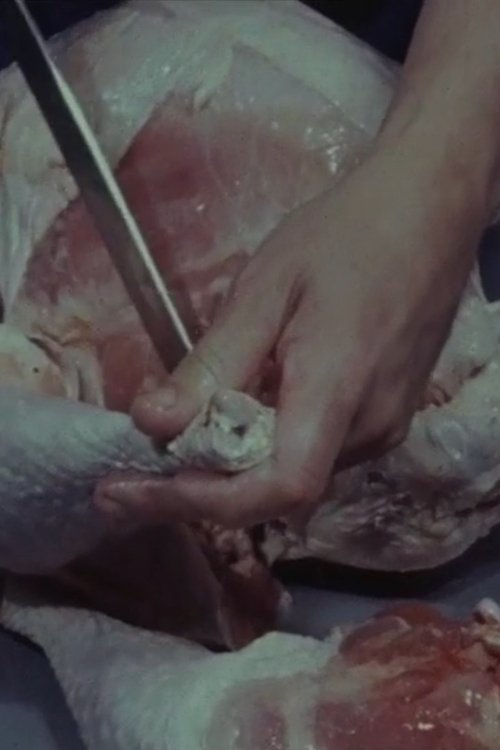
The film is the story of the crude destruction, meticulously done by the artist himself, of a frozen turkey produced in America. The meat is placed in a wooden box and buried in a grave in a field. Dedicated to the fundamental concepts of the ‘lay military priesthood’ (terminology typical of the generals): discipline, honour and other sacred duties, the film is part of a trilogy by Baruchello against the Vietnam War. —Tate Modern
Director: Gianfranco Baruchello
Cast: Gianfranco Baruchello
Cast: Gianfranco Baruchello
Description
Year: 1968
Country: Italy
Director: Gianfranco Baruchello
IMBD: Link
Language : No Language
“A frozen turkey produced in America is cut into pieces, dissected, and minced. The operator, naked, then repackages the resulting material and ‘returns it to sender,’ that is, buries it in a tiny coffin.” Thinking back on the bizarre ritual outlined here, then enacted and recorded by Gianfranco Baruchello, one might wonder whether this is not the treatment the artist has always reserved for cinema, its industrial language, and its mechanical associations of images: cutting it up, showing it naked and raw. Cinema should be served cold: as I watch the calm butchery of Costretto a scomparire (1968), I think back to the title of Baruchello's solo exhibition at the Triennale, Cold Cinema, the first to organically bring together his films and videos as keys to understanding his work as a whole. McLuhan said that cinema is a ‘hot’ medium, which absorbs the viewer's attention by focusing its effects exclusively and intensively on one sense, while cold media such as TV and comics provide ‘lower definition’ data and require greater participation to complete the message. Cooling cinema, in this sense, would mean first of all distancing it, inhibiting the “high definition” from which its charm radiates, making it less engaging and more participatory, decoding its language and introducing noise, appropriating its material and subverting its technique.
Although cinema seems to have cooled off somewhat in recent times (due to the proliferation of devices with which it is consumed, as well as many other factors), in the first half of the 1960s, when two Italian artists decided to tear Hollywood cinema to pieces and “send it back to the sender,” the gesture sounded like a showdown with a still-hot issue, albeit carried out with enviable cold blood. A “subtle revenge, a lazy cinematic massacre”: this is how Alberto Grifi, who co-authored it with Baruchello, defined their Verifica incerta (1964-65), a fundamental operation for avant-garde cinema as a whole, not just Italian cinema. The beginning of the project was sealed by the purchase of 150,000 meters of 35mm film destined for destruction: about forty Hollywood films from the 1950s in Cinemascope, piles of celluloid worn out by hours of projection, which the two went through on an old wooden editing table for eight months, dismembered and joined with adhesive tape into short fragments, in a film that lasts 35 minutes and piles up images from comedies, war films, and westerns, without any consequentiality, between jumps, repetitions, tics, sliding over images without depth, without reverse shots, in a continuous dispersion that chills any possibility of meaning.
The inserts featuring Marcel Duchamp smoking a cigar, the only filmed images (by Baruchello) spared from the violence inflicted on the other clips, serve as a sort of emblem, indicating the first roots of Verifica in an application of the ready-made to cinematic material. The reduction of the film from an event administered by narration to an object, footage, filmed material to be disposed of, is the conceptual switch that opens up infinite possibilities for re-creation within the film archive. Possibilities that are already beyond the ready-made, because the recomposed film is not only an object, but also a film, a score of frames that prescribes its own execution: the performance with which the artist appropriates and discards the material replaces a narrative that has been decomposed and left to jam in its gears. The original project envisaged that the operation would not end with the editing, but with the projection and subsequent dismantling of the film into fragments, which would be distributed to the participants in a real happening, to which the subtitle Disperse Exclamatory Phase would refer.
The first screening took place in Paris in front of avant-garde luminaries such as John Cage, Man Ray, Max Ernst, and, of course, his friend Duchamp. The action, the ritual of destroying the film, did not take place, while the film was then re-printed from the original 35mm onto 16mm film, without using an anamorphic lens in the transfer, thus establishing the horizontal compression of the figures in the version we have all seen: the grandeur of Cinemascope deflated and flattened into a format that belonged as much to television as to experimental and amateur cinema. As traces of that failed ritual, alongside the video projection of the film, there are tables with editing tests: fragments of film dotted with Baruchello's tiny handwriting, encrypted notes from a posthumous screenplay, arising from the random juxtaposition of frames, or from their combination based on numerical series, visual similarities and repetitions. Although the authors explicitly play with Hollywood iconography clichés, Verifica does not get lost in typologies or in the melancholy collectability of many found footage works that followed it, but impassively operates on the residual material of the narrative, its heroes, actions, and passions: in its merciless toy morality, Baruchello and Grifi's work guts all interiority, abolishes all meaning from pre-existing images, and brings out a neutral discourse from the clash of fragments of meaning. (Tommaso Isabella)
[ About file ]
Name: Forced To Disappear.Gianfranco Baruchello.1968.WEB-DL.mkv
Date: Thu, 27 Nov 2025 21:18:58 +0100
Size: 91,168,846 bytes (86.945387 MiB)
[ Magic ]
File type: Matroska data
File type: EBML file, creator matroska
[ Generic infos ]
Duration: 00:14:06 (846.25 s)
Container: matroska
Production date: Thu, 27 Nov 2025 14:05:47 +0100
Total tracks: 2
Track nr. 1: video (V_MPEG4/ISO/AVC) {und}
Track nr. 2: audio (A_AAC) {und}
Muxing library: libebml v1.4.5 + libmatroska v1.7.1
Writing application: mkvmerge v92.0 ('Everglow') 64-bit
[ Relevant data ]
Resolution: 600 x 480
Width: multiple of 8
Height: multiple of 32
Average DRF: 23.919739
Standard deviation: 4.252954
Std. dev. weighted mean: 3.094198
[ Video track ]
Codec ID: V_MPEG4/ISO/AVC
Resolution: 600 x 480
Frame aspect ratio: 5:4 = 1.25
Pixel aspect ratio: 1:1 = 1
Display aspect ratio: 5:4 = 1.25
Framerate: 25 fps
Stream size: 79,075,570 bytes (75.41234 MiB)
Duration (bs): 00:14:06 (846.24 s)
Bitrate (bs): 747.547457 kbps
Qf: 0.103826
[ Audio track ]
Codec ID: A_AAC
Sampling frequency: 48000 Hz
Channels: 2
Stream size: 11,847,720 bytes (11.298866 MiB)
Bitstream type (bs): AAC LC (Low Complexity)
Frames (bs): 39,668
Duration (bs): 00:14:06 (846.250667 s)
Chunk-aligned (bs): Yes
Bitrate (bs): 112.001992 kbps VBR
Sampling frequency (bs): 48000 Hz
Mode (bs): 2: front-left, front-right
[ Video bitstream ]
Bitstream type: MPEG-4 Part 10
User data: x264 | core 146 r11M 121396c | H.264/MPEG-4 AVC codec
User data: Copyleft 2003-2015 | http://www.videolan.org/x264.html | cabac=1
User data: ref=3 | deblock=1:0:0 | analyse=0x3:0x113 | me=hex | subme=7 | psy=1
User data: psy_rd=1.00:0.00 | mixed_ref=1 | me_range=16 | chroma_me=1
User data: trellis=1 | 8x8dct=1 | cqm=0 | deadzone=21,11 | fast_pskip=1
User data: chroma_qp_offset=-2 | threads=48 | lookahead_threads=3
User data: sliced_threads=0 | nr=0 | decimate=1 | interlaced=0
User data: bluray_compat=0 | stitchable=1 | constrained_intra=0 | bframes=3
User data: b_pyramid=2 | b_adapt=1 | b_bias=0 | direct=1 | weightb=1
User data: open_gop=0 | weightp=2 | keyint=infinite | keyint_min=25
User data: scenecut=40 | intra_refresh=0 | rc_lookahead=40 | rc=2pass
User data: mbtree=1 | bitrate=750 | ratetol=1.0 | qcomp=0.60 | qpmin=5
User data: qpmax=69 | qpstep=4 | cplxblur=20.0 | qblur=0.5 | vbv_maxrate=825
User data: vbv_bufsize=900 | nal_hrd=none | filler=0 | ip_ratio=1.40
User data: aq=1:1.00
SPS id: 0
Profile: High@L3.1
Num ref frames: 4
Aspect ratio: Square pixels
Chroma format: YUV 4:2:0
PPS id: 0 (SPS: 0)
Entropy coding type: CABAC
Weighted prediction: P slices - explicit weighted prediction
Weighted bipred idc: B slices - implicit weighted prediction
8x8dct: Yes
Total frames: 21,156
Drop/delay frames: 0
Corrupt frames: 0
P-slices: 9314 ( 44.025 %) #########
B-slices: 11472 ( 54.226 %) ###########
I-slices: 370 ( 1.749 %)
SP-slices: 0 ( 0.000 %)
SI-slices: 0 ( 0.000 %)
[ DRF analysis ]
average DRF: 23.919739
standard deviation: 4.252954
max DRF: 36
DRF<5: 0 ( 0.000 %)
DRF=5: 5 ( 0.024 %)
DRF=6: 4 ( 0.019 %)
DRF=7: 9 ( 0.043 %)
DRF=8: 7 ( 0.033 %)
DRF=9: 15 ( 0.071 %)
DRF=10: 10 ( 0.047 %)
DRF=11: 26 ( 0.123 %)
DRF=12: 35 ( 0.165 %)
DRF=13: 123 ( 0.581 %)
DRF=14: 168 ( 0.794 %)
DRF=15: 174 ( 0.822 %)
DRF=16: 375 ( 1.773 %)
DRF=17: 737 ( 3.484 %) #
DRF=18: 852 ( 4.027 %) #
DRF=19: 996 ( 4.708 %) #
DRF=20: 1271 ( 6.008 %) #
DRF=21: 1397 ( 6.603 %) #
DRF=22: 1251 ( 5.913 %) #
DRF=23: 1597 ( 7.549 %) ##
DRF=24: 1639 ( 7.747 %) ##
DRF=25: 1737 ( 8.210 %) ##
DRF=26: 2082 ( 9.841 %) ##
DRF=27: 1707 ( 8.069 %) ##
DRF=28: 1963 ( 9.279 %) ##
DRF=29: 1436 ( 6.788 %) #
DRF=30: 1122 ( 5.303 %) #
DRF=31: 197 ( 0.931 %)
DRF=32: 124 ( 0.586 %)
DRF=33: 55 ( 0.260 %)
DRF=34: 34 ( 0.161 %)
DRF=35: 7 ( 0.033 %)
DRF=36: 1 ( 0.005 %)
DRF>36: 0 ( 0.000 %)
P-slices average DRF: 20.882006
P-slices std. deviation: 3.413386
P-slices max DRF: 33
B-slices average DRF: 26.56773
B-slices std. deviation: 2.815134
B-slices max DRF: 36
I-slices average DRF: 18.286486
I-slices std. deviation: 3.71179
I-slices max DRF: 29
This report was created by AVInaptic (01-11-2020) on 28-11-2025 05:06:20